
Q&A: Xavier Bray The Wallace Collection’s director on the museum’s ground breaking show by Grayson Perry, the “Hogarth” of our day.
Interview by Mark Riddaway
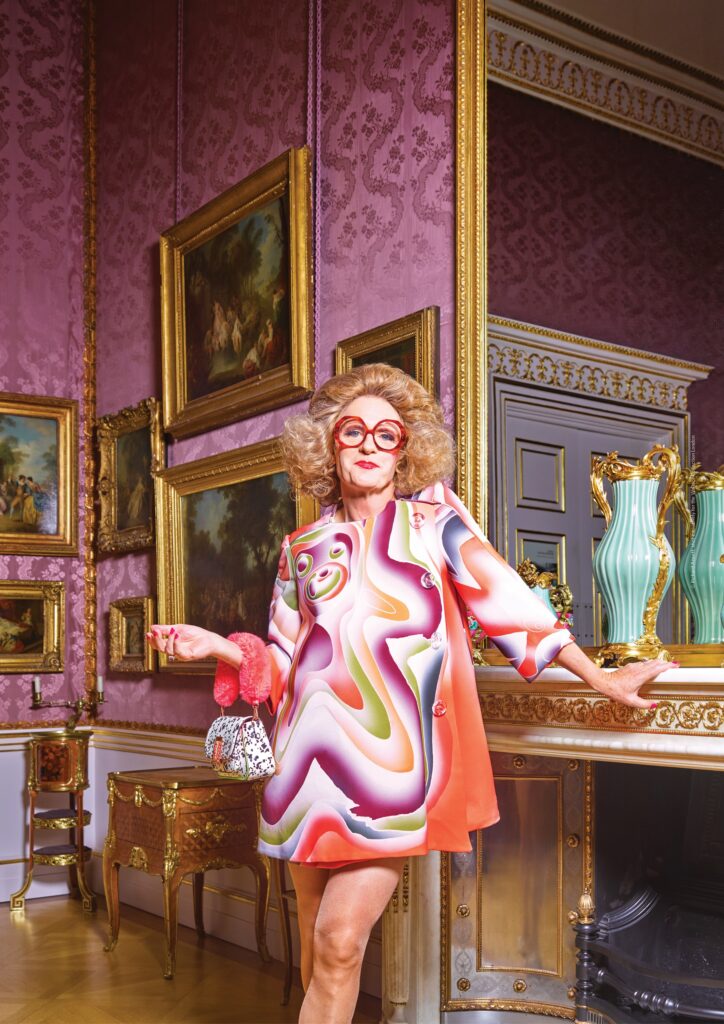
Q: Grayson Perry’s Delusions of Grandeur is the most ambitious contemporary art exhibition ever hosted by The Wallace Collection. In commissioning it, what purpose were you seeking to achieve? A:The Wallace has an astonishing collection – objects, paintings, furniture, armour and so on. The challenge for us is how you make the collection relevant, how you bring its stories to life. A contemporary voice can really help with that. We’ve done a few contemporary shows before, but it’s tended to be artists doing their own thing without really interacting with the collection. With Grayson, it’s been the opposite. For three or four years, he spent day after day here, looking at and engaging with the objects.
Q:Beforehand, what had his personal relationship with the collection been? A:He hadn’t been for a long time. I’m afraid a lot of people say the same: “Oh, I haven’t been for 20years.” That’s what we’re trying to change. But he grew up with soapbox cards – the pictures you used to get in your washing powder – so he knew the Frans Hals Laughing Cavalier. He’d also come across Boucher’s Madame de Pompadourin a children’s encyclopaedia, and he says it had a big impact on him: the king’s mistress, dressed so beautifully. I’m not saying that alone is what inspired him to cross-dress, but he was always fascinated by the image of her in her finery. And of course, there’s the ceramics, theporcelain. He doesn’t love a lot of our Sèvres porcelain, but as a potter he’s certainly inspired by how elevated that art form became in18th century France
Q:How did your collaboration come about? A:It all began with our exhibition of Frans Hals’ male portraits. The show was all about male identity, and Grayson is very interested in image, taste, fashion and gender, so I invited him to do the audio guide. The Frans Hals show forged a friendship, and then over lunch, he said: “Look, I’m going to be 65 soon, I want to do something to celebrate my 65th birthday.” He’s very keen on marking milestones in his career. This seemed the perfect way to do it. I’d seen his British Museum show, the Tomb of the Unknown Craftsman, and was fascinated by how he used the collection and his own art to serve a narrative.
Q:This exhibition certainly has a strong narrative. How did it take shape? A:We got talking. He’s very good at listening and asking questions. Richard Wallace was a fascinating character: an illegitimate child who was handed this collection by the 4th Marquis, then gave it to the nation for everybody to enjoy. But the thing that really struck a chord with Grayson was the fact that in 1942, when the entire collection was sent out of London for safekeeping, Supported by Clementine Churchill, a series of exhibitions were held here to raise money for the Russian Aid Fund. Contemporary artists were invited to exhibit and sell their work, one of whom was Madge Gill, recognised as a forerunner of the outsider artist movement. She was an eccentric East End woman with a difficult up bringing, sent to a Barnardo’s family as a young girl. A tough life. She did these visionary paintings, weird calligraphic drawings, which were created in a sort of trance – she would communicate with a spirit she called Myrninerest. Her story inspired Grayson to create his own character, Shirley Smith, whose life is the foundation of the exhibition
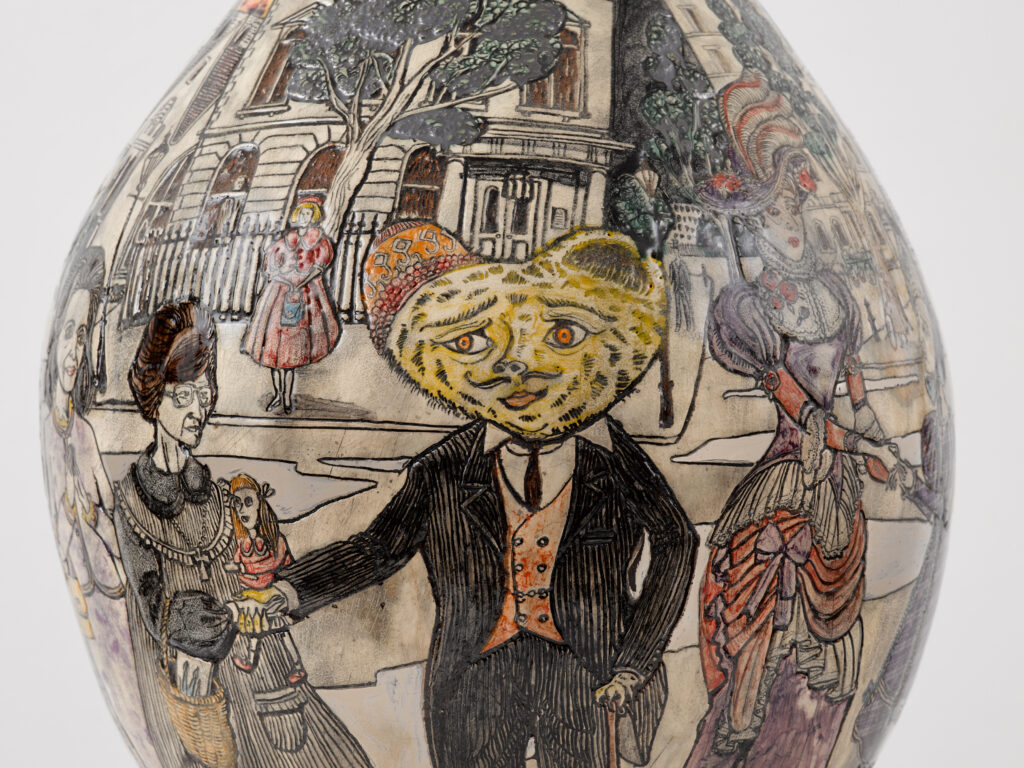
Q:What’s the story he came up with for Shirley Smith? A:She has a very difficult upbringing, with a series of mental health issues. But she comes to the Wallace because it’s free and it’s welcoming. While here, she has a seizure. When she wakes up, she believes she’s the heir to The Wallace Collection and that her real name is The Honourable Millicent Wallace. She starts to make art for the collection based on her visions. Grayson’s exhibition is a homage to her as an artist. It also reconstructs her Islington council house, which she decorated with the works she made. It’s going to be a bit of a head-spinner for some, but the audio guide will have his voice talking you through the life of Shirley Smith and her delusions of grandeur
Q:That’s a lot of story! A:Grayson has always been a story teller. When you look at the tapestries he did back in the late1990s, early 2000s, they all had a really strong narrative. They were like morality plays, but quite mocking and witty. I consider Grayson to be the Hogarth of our day – a very British wit. Here, he’s a national treasure, but when ever I explain what we’re doing to an American, a Frenchman, an Italian, they don’t really get him. He really is the quintessential British artist in that respect.
Q:What form do his / Shirley’s artworks take? A:He has really stretched himself. He’s made a helmet, he’s made a commode, he’s made a tapestry, he’s of course made his usual vases. He’s even made a gun based on one of our guns. As he said himself: “Myjuices are running.” One thing that might surprise people is his interest in AI. For the past three or four years, he’s been using AI to create pieces based on the Millicent Wallace idea. The early ones are pretty ghastly, but he’s been astonished by the later ones. A selection of those pieces will punctuate the show. He’s critical of AI, but he’s also fascinated by it. He’s an artist who’s very in tune with his own traditional training and practice, but also in tune with what’s happening now.
Q:Your exhibitions are usually based on the works of dead artists. What’s it like collaborating with a live one? A: That’s an interesting question. From my point of view, those dead artists are still very much alive. So, for example, working on Goya, his pictures still have relevance – you’re trying to channel the artist using the knowledge you have, almost like method acting. But, yes, it’s true – the curator makes all the decisions. With Grayson, the art was being produced as we were working on the show. There were new things that suddenly came up as his creativity was unleashed. His gun, for example, won’t be in the catalogue because it wasn’t ready for us to photograph. That means we’ve had to be very flexible. But I’ve really enjoyed just letting things develop. There’s been a lot of discussion along the way. Thankfully, of all the artists I’ve worked with, Grayson is the one who talks most wonderfully well. He’s very eloquent, very clear about his ideas, keen to communicate but very involved in the making, in the practice. He’s got a lot of experience and a great outlook.
Q: By working with one of the country’s best-known artists, are you hoping to draw a new audience into the collection? A:Eight years ago, when I applied for the job, I hadn’t been here for ages. I don’t know why, but it was slightly off the grid. When I prepared for my interview, I couldn’t believe the quality and range of the art. What spurs me on now is that this needs to be known by people, it needs to be used. Richard Wallace wanted this treasure to be shared and understood, admired and enjoyed. He was one of the greatest philanthropists of the19th century, and yet people don’t talk about him. People talk about the Rothschilds, but would Shirley Smith enter Waddesdon Manor? She’d probably feel too intimidated. The beauty of the Wallace is that it’s in the middle of London and is free to enter. Absolutely anybody can come in, walk around, seek solace, seek answers and inspiration. In Shirley Smith, Grayson has created a character from nowhere, from the East End, from a working-class background, somebody who had to live rough for a few years, ended up in a mental asylum. And yet here she is, being celebrated. It’s a story that speaks to why museums are so important
28 MARCH – 26 OCTOBER GRAYSON PERRY: DELUSIONS OFGRANDEUR