
One of the country’s best-loved chefs, whose new Cafe Murano opens in Marylebone this summer, on the challenging climate for restaurants, her wildly popular podcast, and why she doesn’t have a PA.
Interview by Clare Finney
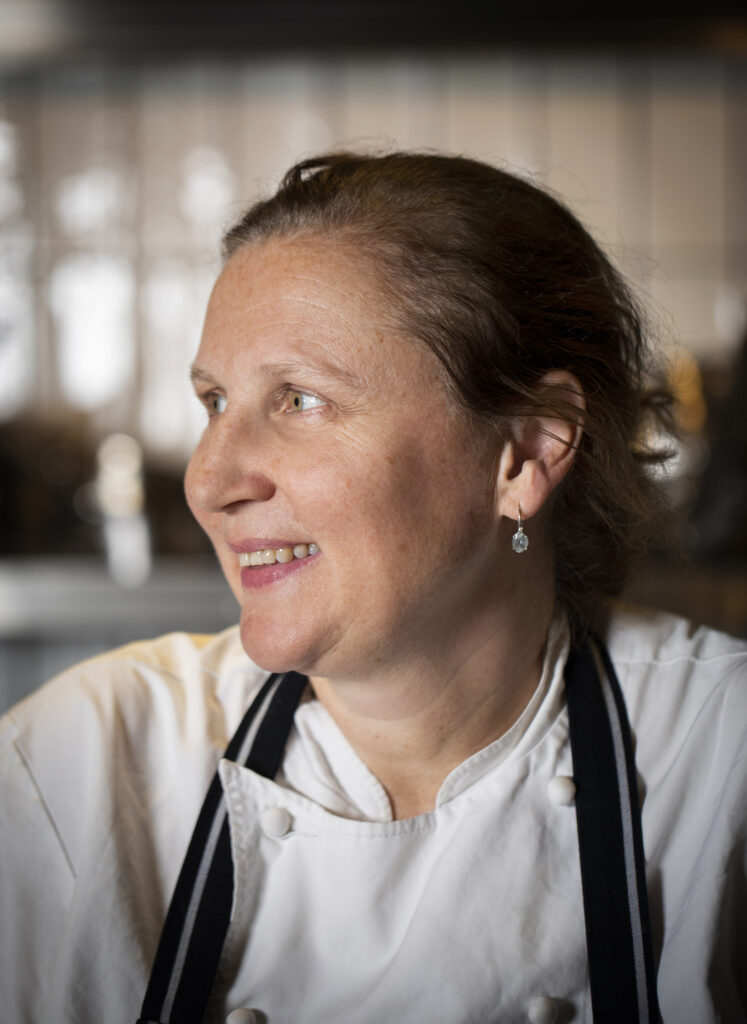
“I think London is in a great place,” Angela Hartnett declares, with the authority of a chef and restauranteur who has been working in the capital for over 30 years and held a Michelin star for 16 of them. “Well, no – that’s a load of bollocks,” she checks herself, laughing. “I think parts of London are in a great place. But that doesn’t mean you can rest on your laurels.” We’re speaking in Marylebone – one of the select parts of London that is, she believes, in a great place – in the site that this summer will become her latest Cafe Murano. Right now, it’s still filled with glasses and crockery from the previous owners. She’s sorting through this detritus when I arrive and as she stops to speak to me, a member of her team continues to workaway. Just the night before, she was presenting the Fortnum & Mason Food and Drink Awards, for which she’s the chair of judges. The preceding week, she was recording back-to-back episodes of Dish, the wildly popular podcast she co-hosts with Nick Grimshaw. She’s cooking at Wimbledon and Venice Film Festival this summer, writing her fourth book – and of course, running her Michelin-starred restaurant Murano and the three existing Cafe Muranos. I am not sure Angela rests at any point, let alone on a pile of laurels.
And she’s right about Marylebone. Of course she is. In February, both Lita and AngloThai received Michelin stars mere months after opening. A month or so later, Claude Bosi – a good friend of hers – announced he was opening Joséphine, and in the weeks following our interview, news broke of popular Peckham-based restaurant Kudu relocating to Moxon Street. The wonder is more that Cafe Murano – her more casual Italian concept – wasn’t already here.It so happens that her chosen site was once the wine bar I waitressed in many years ago while studying journalism. “Gosh, that was a longtime ago,” she says, when I ask if she remembers Hardy’s, and we take a moment to admire the Georgian building: its wide, wisteria-clad windows and sunny dual aspect. The hope is to open in time for diners to enjoy eating al fresco.
Which is why Angela is here today, rolling up her sleeves, working out what can be reclaimed. “As much as we can reuse, we will; I hate sending stuff to landfill.” While this is the fourth Cafe Murano, joining Covent Garden, St James’ and Bermondsey, she’s instantly dismissive of it becoming a ‘chain’. Though as a person and cyclist she moves at speed, she firmly believes that opening a new restaurant demands deliberation. She wants all her sites to be within a cyclable distance of her east London home and she wants them to be fully adapted to the nuances of the city’s neighbourhoods, as well as to her people-first attitude and aversion to waste. “You need your non-negotiables, to know what you stand for, and to put the right team in place – that is key,” she says. “They can all be slightly different, but they must have brilliant people and these common elements. Sometimes doing that is easy – and sometimes, Clare, it’s a bloody nightmare.
Angela is one of the best-loved chefs in the industry thanks to her humour, wisdom and ability to cut to the chase without being unkind. She doesn’t waste a second, but she does make time for people; she’s a celebrity chef who you’re more likely to find behind the pass or cycling between her restaurants than you are on social media. During the pandemic, she was a spokesperson for the hospitality sector, helping the government understand the challenges faced by. Many survived as a result; many didn’t, and many more will close in the wake of price inflation and rising national insurance costs. “There will always be a market for going out to eat – particularly high end. I know that because Murano is full all the time. But it’s hard,” she says, “and now it’s survival of the fittest.”
Government support for – and indeed interest in – hospitality has seemingly disappeared. “I don’t think they care either way when restaurants close, so long as others open, which they do. I think with the Middle East, Trump and Ukraine they feel there are bigger things to worry about – and maybe they’re right. It’s ruthless, but that’s the way it is,” she continues, in the manner that suggests she’s said as much to colleagues and peers many times over. “They don’t want to hear the moaning anymore – and I don’t want to hear it either to be honest. ”She mentions the scene in the Apollo 13 film where the engineers confront the reality of fixing the filter using “nothing but that” – and point to a table bearing the only equipment available to those stuck on board. It’s an analogy she uses often. “There’s no use in thinking, what if we had this or that. The reality is we are no longer in Europe, we had the pandemic, and costs have gone and are going up. I don’t want to hear the problem, I want to hear how to fix it.”
Angela walks the walk even better than she talks it. “For example –second orders. We have a great veg supplier, Smith & Brock, and when I was chatting to him, he said our stopping second orders would save them so much money,” she says –‘second orders’ being the practice of chefs ordering one or two extra items of fruit and veg after a delivery has been made, because they’ve misjudged the amount they need. “It means the supplier driving a van across London to deliver a stick of celery, which is ridiculous! I said, done. No more second orders, unless it’s £100 value,” she says –because it’s those little things that all add up, and any unnecessary costs end up being passed on. Staff retention is another thing. “No one is staying anywhere more than six months at a time – they’re all flipping around,” she says, which means the wrong people end up in the wrong jobs. “You’ve got to look after your team. Invest in them, and make sure when they do leave your restaurant they do so as better people.”
The restaurant world put to rights – for now – we move on to the Dish podcast, which has made her more of a star in three years than the Michelin guide has in almost 20. It’s a gig which came about quite serendipitously: she was Nick Grimshaw’s first choice of co-host when he ran the idea for Dish by Waitrose, which sponsors it, “but everyone said he’d never get me on board, because I was too busy.” Indeed, when an invitation to audition came through to her, Angela didn’t read the email properly. “I thought he was interviewing me on a podcast,” she laughs. And that would have been that had the two not got on so well. “I don’t think anyone anticipated the chemistry we’d have. We basically rip the piss out of each other, and it works. People seem to enjoy it.
This is true of the 10 million viewers and listeners who tune in every week across audio and video formats, but it’s also true of her guests. “We had Cynthia Erivo record last week and she said this was the only podcast she’d wanted to do,” Angela says, smiling. The format is simple: Nick shakes up a cocktail to start, Angela cooks a Waitrose recipe (which is the only real mention the supermarket gets), then they chat over lunch. “We were the first to actually cook and eat food on a food podcast,” she says, and eating together makes everyone open up. “We have fun,” she says simply – and the knock-on effects have been huge. “Some people used to recognise me before, but they really recognise me now. And it’s changed the demographic at Murano; it’s a much younger crowd.” For decades, the first question Angela tended to be asked was either about Gordon Ramsay or about Michelin’s relationship with female chefs. “Now the first thing is Dish, Dish, Dish,” she smiles.
That must be nice, I proffer, to be asked about her work as a person rather than as a figurehead, or because of a famous/infamous former employer. “Oh yes,” she agrees – and the introspection ends there. She’s not one for navel-gazing, and she will never be drawn on Gordon. They’re good friends; this summer, she’s going to his daughter’s wedding, and now he and Marcus Wareing are speaking again, she’s taking them both out for their traditional Christmas lunch. “Gordon is great, and he’s still going, whether you like him or not,” she observes. “I’ve got a lot of time for Gordon.” As for Michelin, which took a battering earlier this year when only one of 22 chefs awarded their first star was female, she is disappointed that there aren’t more woman-led restaurants with stars in the UK in 2025. But the bigger question for her is how relevant stars are to many of these young chefs, some of whom have openly declared that they’re not fussed by them. Angela is immensely proud of hers, and of her team for retaining them year after year. “But is the Michelin guide going to be relevant to everyone in 20 years’ time? That’s more the question for me,” she observes. Her wish is to embolden women in the industry to shout about themselves, whether they’re star-chasing or otherwise. “It’s only in the last few years that I’ve felt confident charging what I charge now for work, when someone pointed out how much I was undercharging,” she says. “I think women still tend to hide their light under a bushel.”
Her mobile phone lights up, as if to emphasise her point, reminding me of the time, and of what must necessarily be my last question. To the admiration – and occasional frustration – of colleagues and peers, Angela doesn’t have a PA. To see or speak with her, you liaise with her directly. Why does this work for her? I ask – and she laughs heartily. “I’ve even turned my read-receipts off, so no one can see if I’ve read my WhatsApps,” she says mischievously. She likes being in control of what she does and when. More pertinently, though, there are already too many people in her professional life. “My problem with PAs is people have to ask them to ask me to do something,” she says – and if there’s one thing that tries her patience, it’s convoluted communication. “It’s happening with an event at the moment. I speak to someone who speaks to someone who speaks to the client, and I think, bloody hell! Why can’t I just get together with them in a room and we can get it done? It drives me insane!” she exclaims, before conceding that she probably will have to employ someone soon. “I am debating it, I have to say. I just need to find the right person.”
Given how long it took us to arrange this interview, I’m minded to agree – but then, the joy of Angela operating like this is that when you do meet her, she’s fully present. There’s no lengthy email chain, no overly cautious press officer seeking copy approval, no clock-watching, no suggestion that your time matters less than hers. At the start of our conversation, she remembers I’m getting married this year and asks how the menu planning is going – and when I leave, she checks that I’ve got my helmet, remembering that I cycle. She is the busiest, most famous, and yet most thoughtful person I know – so no one really minds the slight air of mystery that surrounds where she might be at any given time. “If I’ve said I’ll do it, I’ll do it,” she says. “Claude Bosi’s another one,” she remembers. “He says, you never answer your texts. I tell him, bugger off – you’re even worse than me! And he is,” she laughs. “He knows that. So I’m looking forward to our being round the corner.”
Cafe Murano, 52-55 Dorset Square, W1U 7NQ