
The chef-founder of Roketsu on expressing the kaiseki tradition, creating harmony on a menu, and bringing artistry to airline food.
Words by Claire Finney
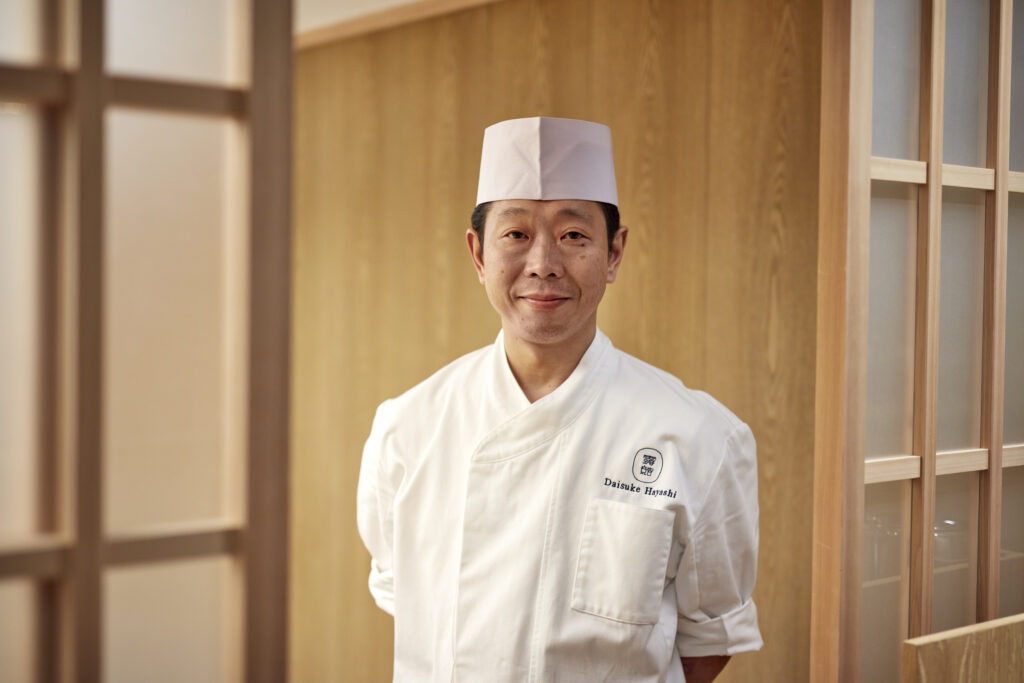
Upon first opening the elegant menu at Roketsu, these are the words that leap out from the page. It’s an old epigram, the menu goes on to explain, from the ancient Chinese philosopher Zhuang Zhou, which inspired the 16th century teahouse for which the restaurant is named and which has proved central to the philosophy of its chef-founder Daisuke Hayashi. Its message – according to Daisuke – is that once one has successfully conveyed one’s purpose or meaning, it no longer matters how that purpose or meaning was conveyed.
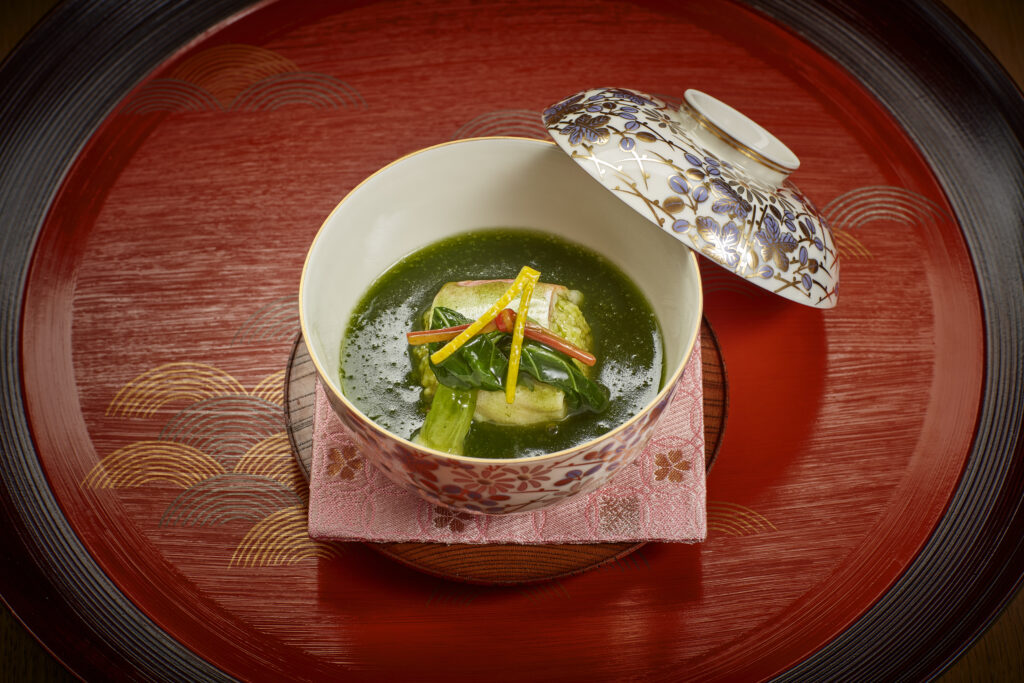
It comes back to me the following morning, when I return to the scene of my evening meal to interview Daisuke about it, and the principles behind ‘kaiseki’, a form of dining rooted in Kyoto, the Japanese city that for over 1,000 years was the seat of the imperial court and the country’s cultural heartland. At its simplest, kaiseki refers to a formal meal consisting of multiple, meticulously prepared courses served in a prescribed order – though there is far more to this tradition and its modern-day interpretation than first appears.
The problem is, I have eaten it. The rabbit is caught, the fish is landed and now – according to Zhuang Zhou – any thoughts as to how and why it got to me should be irrelevant. Daisuke is patient, considers my questions with care and gracefully tolerates my butchering of terms like ‘shun’ and ‘wabi’. Yet the more I endeavour to decipher my meal, the more I feel like that guy who, rather than laughing at a joke, asks the teller to repeat it more slowly because they don’t understand what it means. Nevertheless, I persist – for your benefit, dear reader, and because the sake pairing we enjoyed last night has left my memory hazy as to the precise details of Daisuke’s nine courses. Though Roketsu is the first kaiseki restaurant to open in Britain – the first in Europe, to the best of his knowledge – the cuisine is steeped in the Japanese tea ceremony and can be traced back to the 15th century. As the taking of tea evolved into a ceremonial ritual, so it became necessary to serve food with it. “Tea contains caffeine, which can feel heavy in your stomach, so people started having a bit of food alongside. This developed into multiple courses,” says Daisuke. Other influences include the cuisine of the imperial court, the culinary traditions of the samurai and – at the opposite end of the spectrum – the practices of Buddhist monks, who brought a purer and more ascetic approach to tea and meals, as they did to most things.
“Kaiseki is an expression of Japanese culture through food.
One needs a depth of knowledge and understanding in order to keep traditions
and continue to make new things.”
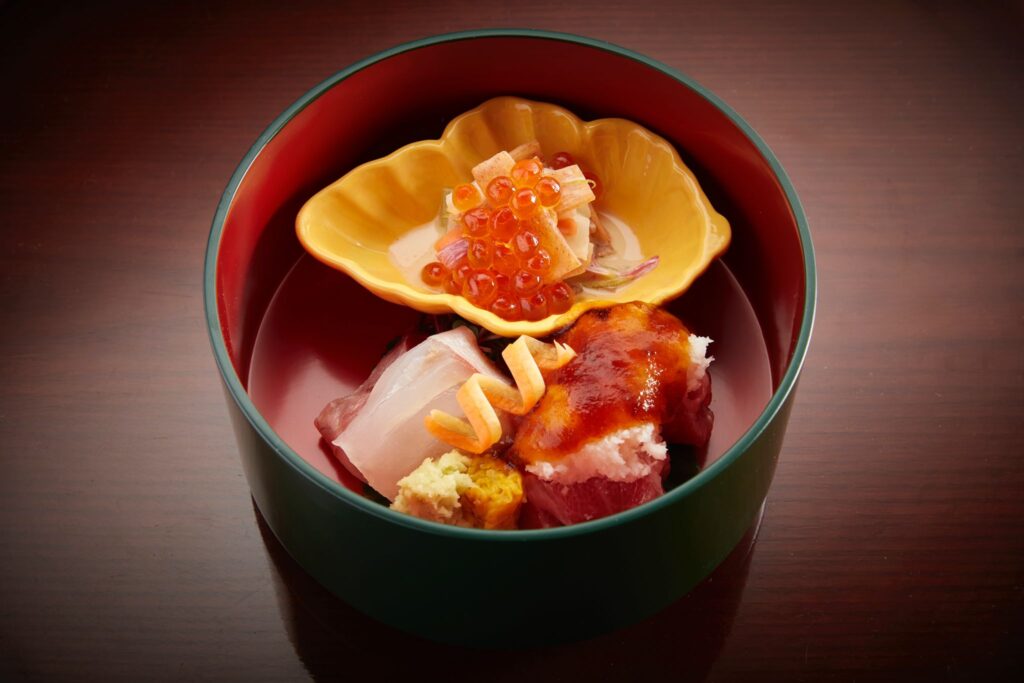
Like many of the world’s great cuisines, kaiseki has been centuries in the making, and its origins are far too complex to do justice to within the course of one short article. Its closest equivalent – in the West at least – is French haute cuisine, the history of which is similarly rooted in the ruling classes and burgeoning bourgeoisie. As with haute cuisine, there are multiple courses – at least six, and sometimes as many as 15 – all of which follow a predetermined order. The sakizuke (the equivalent of the amuse bouche) is typically something small and pickled. We had a fig with Japanese mustard. This was followed by the hassun – a vivid array of cured, pickled, grilled and stuffed seasonal seafood and vegetables designed to celebrate hyper-seasonality. The soup was a rich broth known as a dashi, and highly revered as the hallmark of a chef’s ability. The same could be said of French soups and sauces – though no French-born consommé has been brewed from bonito flakes and kombu seaweed. The seaweed – “the best in Japan,” says Daisuke – is sourced by him from Kikunoi, the famous century-old restaurant at which he learnt his craft.
And so it continues, course after beautifully presented course. Like haute cuisine or any multicourse dinner, kaiseki demands a quantity of crockery so great you feel obliged to raise one of the many glasses to the pot washer responsible for cleaning it all. In the case of kaiseki, this servingware changes with the seasons, so every month sees a different range of plates and bowls. “The servingware has a season because each piece is designed for the dishes,” Daisuke says simply. This ensures the overall harmony of the dish (and that is key, for kaiseki), and dictates the portion size so as to minimise food waste. Even the garnishes come in their own bespoke bowls, like pageboys dressed up in tiny, tailormade suits and shoes.
Here the ascetism of kaiseki comes into play. “One of my fundamental philosophies is that my food is good for your health. Sushi is popular because people think it is healthy – but it has a lot of salt and carbohydrate,” Daisuke explains. Ditto tempura, which like sushi has risen rapidly to popularity in the last few years “because it’s easy to understand, and contains sweetness, fat and umami. It’s delicious,” the chef concedes, “but it is not necessarily healthy. Kaiseki thin slices of aubergine, and even the Inaniwa noodles they came with were lighter than one might expect, thanks to being hand pulled. Omakase – the predominant form of Japanese fine dining found in London – is a fine tradition, Daisuke explains, but it is often sushi-led, partly because the tradition is dictated by the customer’s preferences as much as it is the chef and the seasons. “Kaiseki is an expression of Japanese culture through food. One needs a depth of knowledge and understanding in order to keep traditions and continue to make new things,” he says. “Omakase is is all about finding the balance of nutrition.”
As such, anyone rocking up to Roketsu ready for an onslaught of sushi and fried stuff will be pleasantly surprised by how light the meal is. Rice featured just once over the course of nine intricate courses, as part of a hassun course that featured (among many morsels) a cool clam and cucumber salad, salmon roe stuffed into sake-cooked prawn and a slender finger of saffron-cooked rice topped with grilled Cornish mackerel. Tempura made a fleeting appearance in a featherlight batter encasing courgette flower, new ginger and not so deep.” Where omakase chefs acknowledge their audience, and even adjust the courses based on their diners’ desires and needs, kaiseki chefs prefer the fourth wall to remain intact throughout their performance. Daisuke loves art and is an avid collector, and he views food in the same light. “If they can know it and understand it there is harmony there between the chef and the people who have the food.”
To Daisuke and his team at Roketsu, the parable of the fish and the rabbit says: “We don’t need words to establish a heart-to-heart conversation and understand each other.” It’s true that, upon swallowing my final scoop of peach jelly and mint ice cream, I felt a deep sense of contentment. Yet being the impatient, inquisitive creature I am, I cannot help but think contentment would have been enhanced by my knowing then what I will learn the next day.
As well as the (tightly potted) history of kaiseki, I discover several things that make Roketsu truly remarkable. I learn that Daisuke was just six years old when he first set his mind on becoming a chef, inspired by fishing with his father, and to this day – every day – he insists on seeing the fish before buying from his suppliers. His fish are all British, as are his fruits and vegetables – even the Japanese varieties, which he commissions specially from a grower in Cambridge. In fact, the only ingredient that comes from Japan beyond the aforementioned sake and seaweed is Kagoshima wagyu beef.
I learned that at Kikunoi in Kyoto, he trained for many years under the legendary chef Yoshihiro Murata, one of only 10 chefs in the world to have seven or more Michelin stars to their name. I learned to my delight – posh plane food being a particular fascination of mine – that Daisuke supervises the in-flight meals for business and first class passengers on four European routes for Japanese Airlines. “There are limitations to what I can do on board, but I was taught by my master Murata that there is no such thing as ‘no’. Nothing you ate yesterday is available in the sky,” he smiles, but it is nonetheless a distillation of his craft. “I have to think how to do the best for this situation. I think separately.
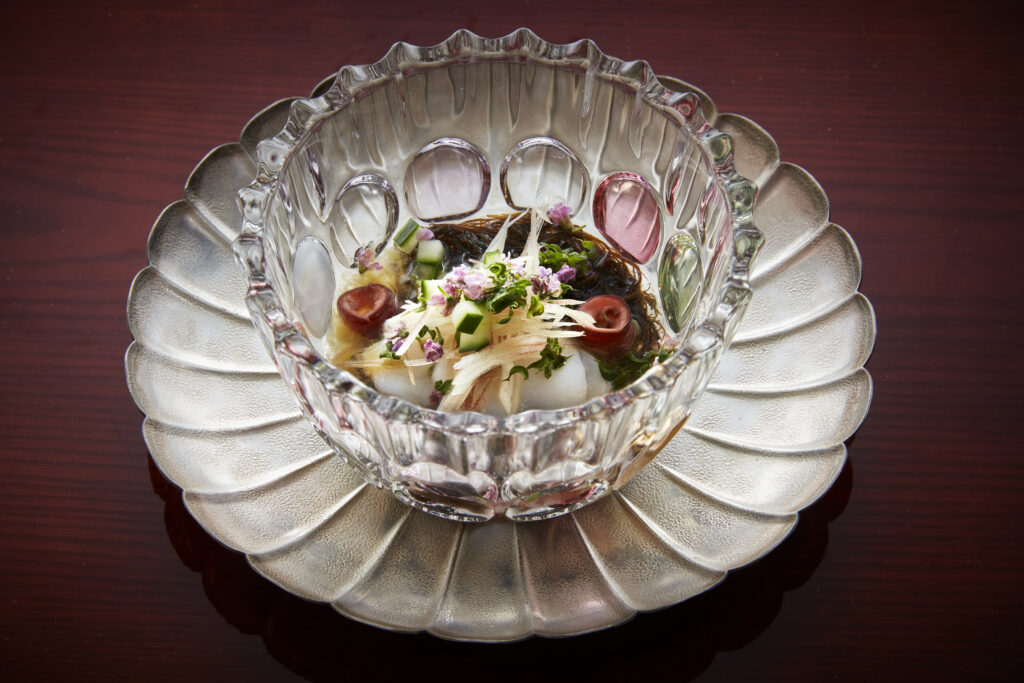
“To work is to continue thinking how to be the best you can be,” he concludes – and I finally feel I have reconciled Roketsu with Zhuang Zou’s parable. It’s not that the ingredients, expertise and craftsmanship that go into making a meal here so special do not matter; it’s that they shouldn’t detract from the experience as a whole. The wood panels are Japanese hinoki wood, preserved over 100 years in Kyoto and shipped from Japan. The plates and bowls are handcrafted and bespoke. The food is as fundamental as the philosophy. But the purpose is a harmony in which no single note takes centre stage; in which each plate, person and panel sings and is just so.
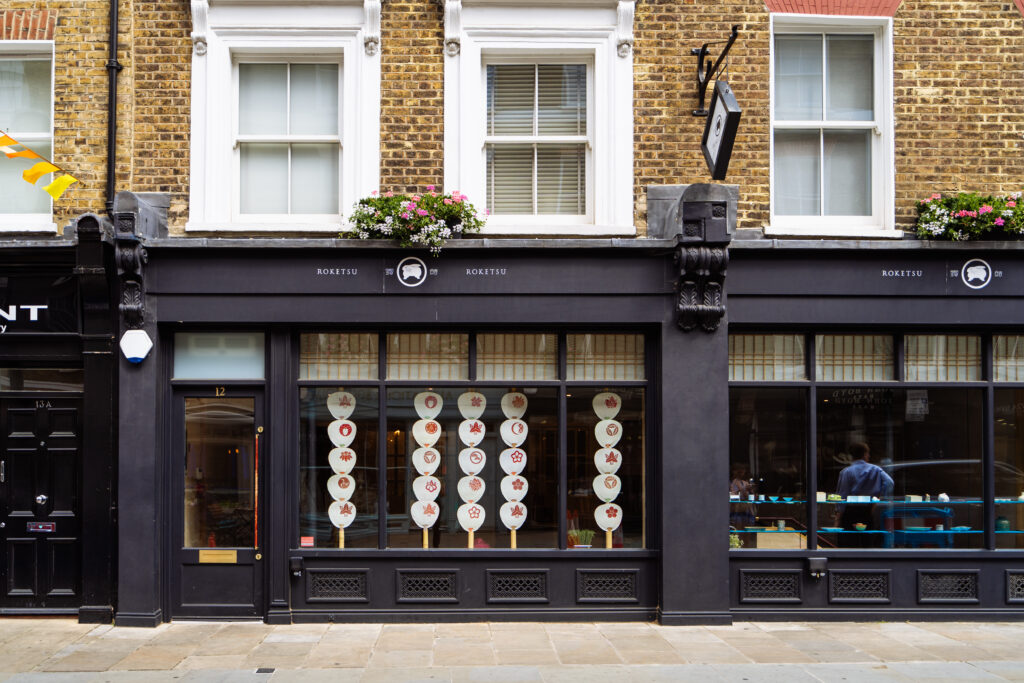
Rokestu, 12 New Quebec Street, W1H RRW