
The eponymous owner of Mandy Zhang Art on emerging Asian artists, cross-cultural dialogue and the importance of philosophy.
interview: Emily Jupp
Q: Having recently opened on Seymour Place, have you made friends with your neighbours?
Yes! I’ve lived on this street for two years, so I already knew some of the shop owners. I go to So French for coffee and I love the owners there. Every week I go either to Donostia or Lurra for Spanish food. I just love Marylebone so much. The vibe is perfect for me. I’m very lazy, I don’t really want to travel very far and Marylebone is very central, but not too noisy, not too crowded. I can still get everything I want here – and it has a village feel to it.
Q: What brought you to London?
I’m originally from China – Chengdu, Sichuan, the spicy food area! I’ve been in the UK since 2019 when I came here for my master’s at the Royal College of Art, where I studied contemporary art curation. We got the chance to make things, do physical projects and make exhibitions happen. I took a year off because I didn’t want to do the whole pandemic, online thing, so I graduated in 2022. I already knew then that I wanted to start a platform to support Asian artists.
Q: Is your gallery covering the entire Asian continent?
So far, we’ve been working with east Asian and south Asian artists, but we’re looking to collaborate with more middle Asian artists: Kazakhstan, Mongolia. I was in touch with an artist earlier this year from Kazakhstan, and their work is just so, so cool! You can see that they seek inspiration from Western art, but not that much. It’s so different.
Q: Do you make art yourself?
No. Not at all. Maybe I shouldn’t say this, because it’s not a very good image of my home country, but I’m going to tell it anyway. In China, there’s a very weird and not nice judgement about people doing art. In parents’ minds, especially the older generation, you only do art because you can’t do well academically. It’s sad. I studied philosophy because it was a good middle ground for me and my parents. I wanted to do art. I knew through this path, I could get there eventually.
Q: What did you gain from studying philosophy?
The way to see the world, to learn the world, and to think about everything in a more rounded way. Philosophers are always trying to find the ultimate power behind everything, to explain how the world runs. Nowadays, people care about practical issues, which probably matter more in real life. But those great thoughts have existed for thousands of years and they’re still important.
Q: How does that relate to art?
I think art has the potential to live that long – thousands or tens of thousands of years. And it’s also not just the visual, but the concept, the idea of the art behind it.
Q: What are the ideas that you want to explore?
At the moment, I’m focusing on cross-cultural dialogue because a lot of the artists I work with, they have experience of living in both Asia and Western places. So their life experience itself is a cross cultural thing.
Q: Are there any culture clashes that you come across in your day to-day life here?
Oh, a lot! It’s a very different culture. I couldn’t do English irony. When my friend and I go out for dinner, he will finish his whole plate and say: “I hate this.” The first time I heard it, I was like: “What are you talking about?” And it’s very funny, because when we went to China, he tried to do the same at the Chinese table. And the waitress was just like… horrified. She was afraid he was going to ask for a refund! I’m getting used to it now.
Q: Tell us a bit more about the capacity of art to bridge that cultural gap. Does it? Can it?
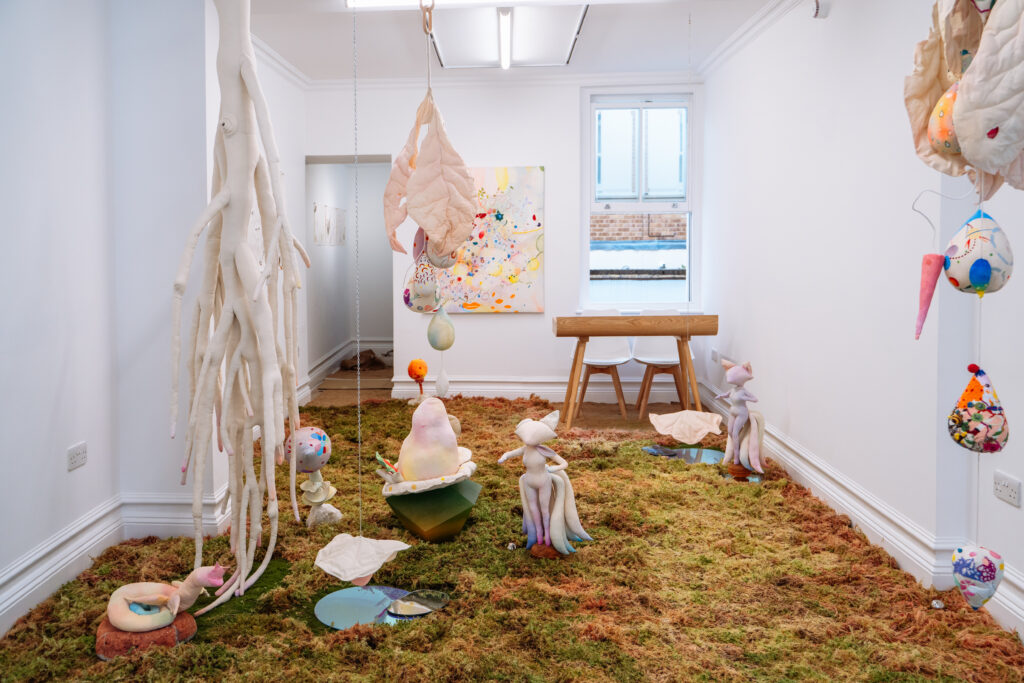
I think great art should speak for itself. Currently we have a display by an artist called Can Sun – it’s his first solo exhibition in the UK and it’s deeply rooted with his Chinese background. But you have no difficulty understanding the work, right? It should be open to different interpretations. For example, there’s a photograph of a lattice of cigarettes, interwoven like a cushion. The artist is trying to say through that work that every one of us is like those cigarettes. We’re interwoven with each other in society. We’re burning ourselves to give out something. At the same time, we might hurt each other, but we can’t really escape the hurt. It is a tiny bit sad, but there are people seeing it as: “Oh, a cushion. Very cute.” And there’s an art critic who came one day and wrote a review guessing that the artist had a problem quitting smoking. Every interpretation makes sense, and I love it.
Q: Covid unlaunched a wave of racism targeting east Asian communities. Did that affect you?
That’s one of the reasons why I wanted to start doing this, because the discrimination against Asians was bad around the same time as the Black Lives Matter movement. I was seeing Black people supporting each other and creating this huge movement, but Asian people are not that together yet. I feel like I should do something. I want to support my people. I want to support the culture I’m standing in.
UNTIL 7 JULY
SILIA KA TUNG: GREEN ROCK
AND THE MAGIC MOUNTAIN
Mandy Zhang Art
16 Seymour Place, W1H 7NG
mandyzhang.art