
As Trishna prepares for a summer series devoted to the food and culture of Kerala, executive chef Sajeev Nair introduces the distinctive cuisine of his home state.
Words: Mark Riddaway
Images: Marcus Cobden
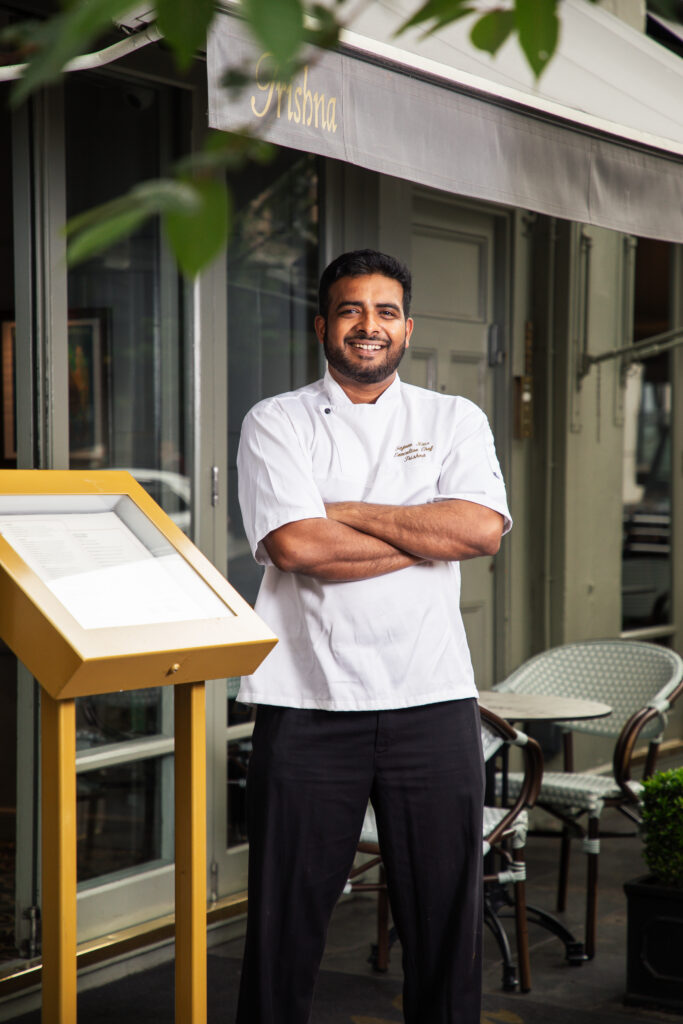
When Britain first fell in love with Indian restaurants, the food they served had very little to do with India. The original 20th century wave of curry houses, with their flock wallpaper and sugary kormas, were often owned by Bangladeshis or Pakistanis, and their menus were shaped to suit the reluctant British palate, with its taste for gentle spicing and thick gravy. The result was a new hybrid, Indian in name only. “People in England didn’t used to be as daring as they are now,” says Sajeev Nair, executive chef at Trishna, Marylebone’s much-loved Michelin-starred Indian restaurant. “Nowadays, we don’t tone down the spice. In fact, the owners here get angry if it’s not spicy enough! We’re doing real, actual Indian cuisine.” And really, that means Indian cuisines, plural. “In India, every 100km you travel, the language changes, the accent changes and the food changes,” says Sajeev. “You can’t really have an Indian restaurant that covers the whole of India. It’s impossible.” So, Trishna doesn’t try. Since it opened in 2008, the restaurant has devoted itself to the food of India’s southern coast: Goa, Karnataka, Kerala. This July and August, the focus is tightening still further, with a summer-long celebration of the food and culture of Kerala, Sajeev’s home state. The Kerala Summer programme will include a new lunchtime and early-evening menu devoted to the region, drinks developed in partnership with Tanqueray Nº Ten to celebrate the flavours of Kerala, plus workshops, masterclasses and installations with the same geographic themes.
Stretched along the southwest seaboard, with the Arabian sea on one side and the mountains of the Western Ghats on the other, Kerala is, says Sajeev, “like a narrow belt. But it has everything there: sea, mountains, hills, forests, cities.” One thing it has in great abundance is spice. Since ancient times, Kerala has been famed as a source of exceptional and abundant black pepper – a hugely valuable resource that made it a magnet for both trade and invasion. “At Trishna, we get a lot of our spices from Kerala. We get cardamom from the Idukki hills – it’s the most famous cardamom in the world – and we get Keralan black pepper too.” Sajeev talks with great affection of the feasts served up each year at the Keralan festival of Onam – dozens of dishes, most of them vegetable-based, laid out in small piles on a vast green banana leaf. “In fact, whenever there is an occasion, we do this,” he says. “When I got married, we had the same feast.” He also tells of the stunning Keralan breakfasts, renowned throughout India: “It’s a lot of dosas, appam and stews. Something called idiyappam, which is steamed hoppers. The fish pollichathu – whole fish grilled in a banana leaf – is very famous too.
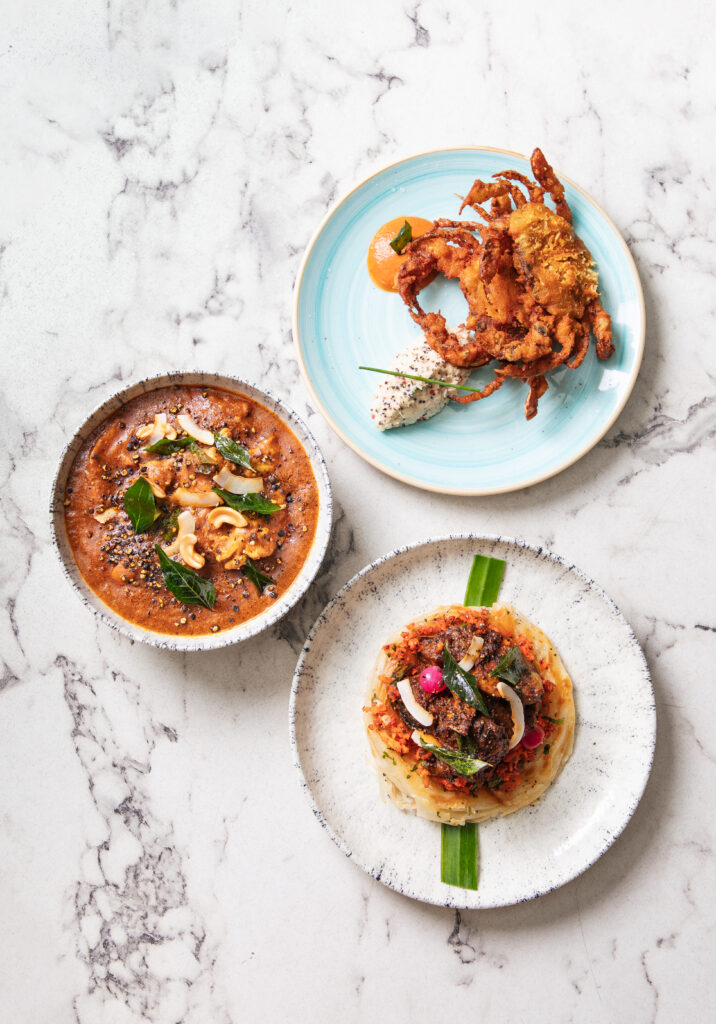
Like most of India, the cuisine includes an abundance of vegetable dishes. The same is true of seafood from the 600km coastline. “We eat a lot of prawns, oysters, mussels, fish,” says Sajeev. But meat, too, plays a significant role. One notable characteristic of Kerala – a result of all those traders and invaders – is the religious and cultural diversity of its people. Most Keralans are Hindu, but the state also has unusually large and deep-rooted Muslim and Christian populations, which adds to the breadth of the cuisine. “India is basically a chicken and fish-eating country, but Kerala is one of only three states where people eat beef. There are lots of Keralan beef dishes, such as the Malabar porotta & beef fry on our menu,” says Sajeev. “There are also lots of Christians there who eat pork – in fact, everything is eaten!” “Everything” extends to game, particularly in toddy shops, the state’s lively drinking establishments where locals imbibe palm wine and vibrantly spicy snacks. “We have this toddy shop cuisine where you’ll get wild animals like rabbit, frog, deer, duck, which isn’t something you’ll find in other parts of India. People go there to drink, but they also have family get[1]togethers – it’s like pub culture in England.”
It’s in England that Sajeev has mastered his craft as a chef. He was born in Kerala, but when he was 10 his family moved to Delhi, around 3,000km to the north. It was there, in India’s capital, that he completed a hotel management course and began working in kitchens. At the age of 22, after just three years as a chef, he made the jump to London. “I wanted to explore more, I wanted to move out of India, and London was always the first choice – it’s English speaking, it’s multicultural, it’s exciting.” His first impressions? “It was very cold.” In 2012, Sajeev arrived at Trishna, then still in the early flushes of its success. After starting as sous chef, he was promoted to head chef after less than a year when founder Karam Sethi left the kitchen and set about transforming the London dining scene through his family’s JKS Restaurant Group. Under Sajeev’s stewardship Trishna has retained its stellar reputation – and its Michelin star. The secret? “Consistency,” he says. “Consistency of suppliers, of cooking methods, of staff. Staff are integral. Most of ours have been here eight to 10 years, so it’s a stable team. There aren’t hits and misses. We make sure that every single plate is of the same standard.” Despite being away for so long, he still feels Keralan through and through. “I’m 100 per cent Keralan,” Sajeev insists. “It’s an integral part of who I am.” This summer, he’ll give us a taste of exactly what that means.
TRISHNA
15-17 Blandford Street, W1U 3DG
trishnalondon.com