
The founder of luxury womenswear label Suzannah London on how to break a dress code without ruffling feathers, and why big hats are staging a comeback.
Words: Lauren Bravo
Images: Josh Shinner, Rachel Louise Brown
Q: You’ve recently launched your
first vacation collection. But we’re
not talking cut-offs and flip-flops,
are we?
A: It was inspired by a family holiday
to Barbados last year. I bumped into
two of my clients there, and while
we were chatting about which of
their Suzannah pieces they bring
on holiday, they said, “Why don’t
you do cotton? We want to wear your
pretty, polished style, but in cotton.”
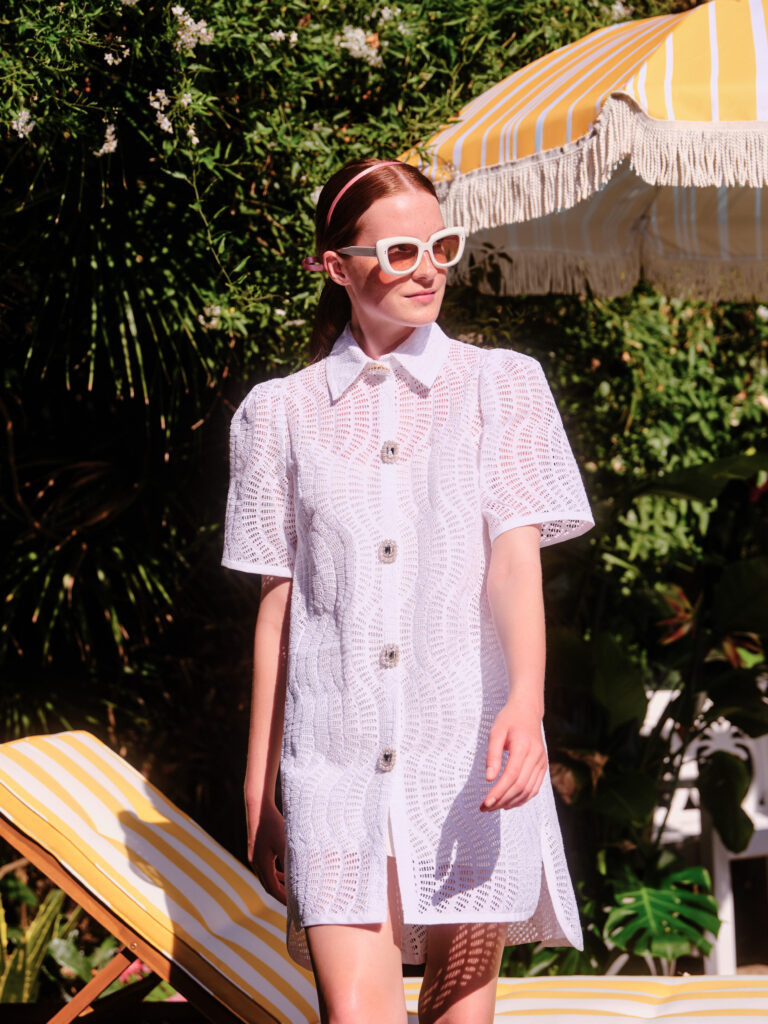
Our bestselling vacation pieces so
far have been luxury kaftan dresses,
which are really gorgeous and not at
all sheer, so you can throw them on
over your bikini or wear them into
town. I took my holiday photos from
Barbados and asked an illustrator
friend, Susannah Garrod, to paint
elements from them, which we then
placed around a dress. There’s
another with palm fronds, and
another dress called the Carmel
which is covered in lemons and
jasmine flowers, inspired by a road
trip I took around California.
I enjoyed developing the collection
so much. It was such a joyful,
optimistic process.
Q: We’ve just lived through an
era of extreme casualisation.
Are people ready to get dressed
up to the nines again?
A: Yes! But clothes also have to
have a lightness and a wearability
to them these days. Our customers
don’t want to discard that dress or
suit after one wear – they want to
be able to style it for daytime, for
several other events, to keep it for
next year and the year after. There’s
not a lot of whim-buying that goes
on anymore; it’s about considered
choices. Comfort really came into
play in the pandemic too, from
wearing all that athleisure. People
don’t want to feel restricted! We offer
a fit service to get things just right.
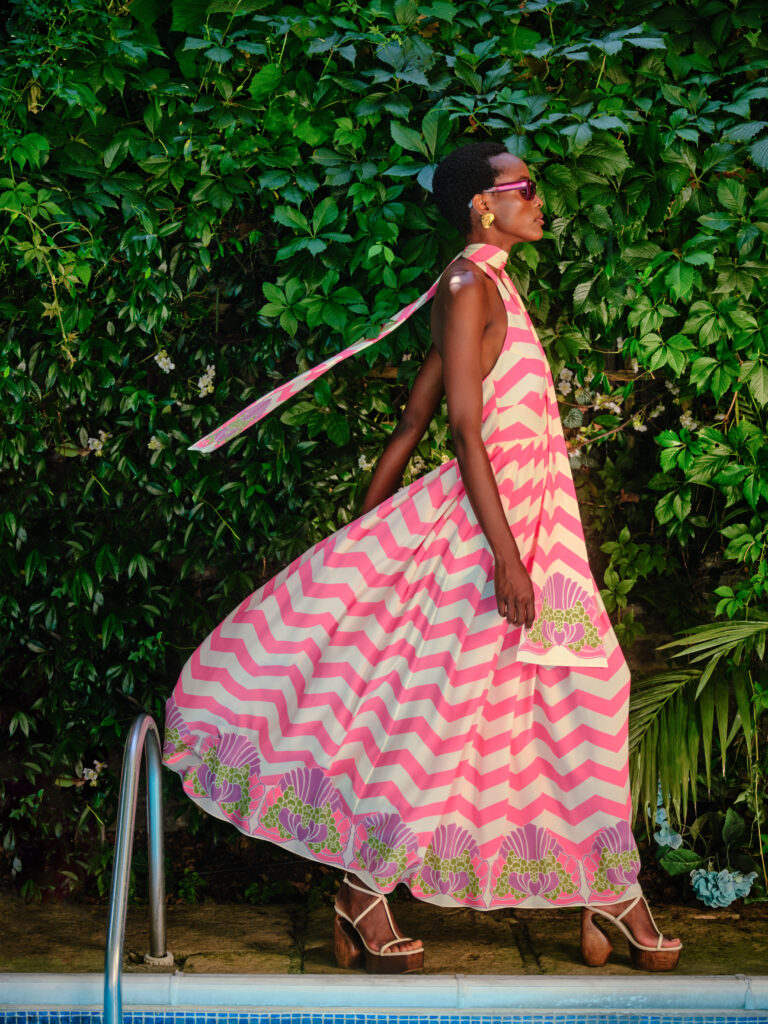
Q: From royal enclosures to red carpets, you’ve dressed clients for some of the most prestigious events in the global calendar. You must be an expert in cracking mysterious dress codes… A: We’re very lucky in that we tend to dress people for special moments in their lives. Milestone birthdays, destination weddings, royal occasions – it’s a privilege to be involved in that world, and we have a lot of experience in helping clients get it right. “White tie, black tie, what do they mean?” “What do I wear to the Kentucky Derby?” We hear a lot of these questions and have generally covered them all before. But we always refresh ourselves and do our research, because times change, styles change, and we want our customers to feel confident that they are wearing absolutely the right thing. They trust us to know, and we put a lot of energy into making sure we do.
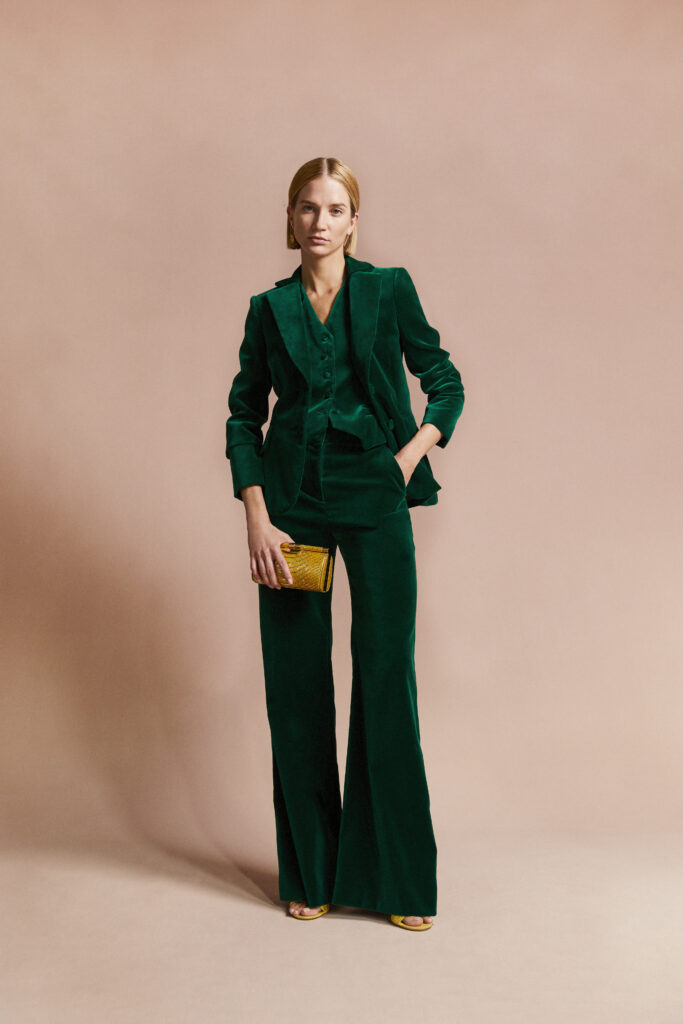
Q: But doesn’t great style mean breaking all the rules? A: I think the rules are more flexible now than they used to be, but of course it just depends where you’re going. Generally, there are stylish adaptations you can make to the framework, and I think it’s really appreciated when people make an effort but bring out their own personal style – it all adds to the mix, doesn’t it? It makes things more exciting. If a dress just isn’t your style, it’s better to go to Ascot in a three-piece trouser suit and a great hat.
Q: Speaking of hats – is the fascinator dead, or is it merely hibernating? A: There’s definitely been a migration towards bigger hats with wide brims again. We’ve developed what we call “straw couture”, which is a sustainable straw hat collection, and our bestselling hat has been a really large, Audrey Hepburn-style hat with a massive pink bow. A hat you dream about! But big hats don’t suit everyone. If you’re petite in height they can be more of a challenge to wear, so in that case I would say a structured headband is the way forward, rather than a load of frouff. “There’s not a lot of whim-buying that goes on anymore; it’s about considered choices. Comfort really came into play in the pandemic too, from wearing all that athleisure. People don’t want to feel restricted!”
Q: Tell us about your own style evolution. Did fashion always excite you? A: Always. My mum was immaculate, and fashion was a big part of my upbringing. But I was limited growing up in east Yorkshire – there weren’t a lot of fashion shops around. We used to go to an amazing vintage shop in Leeds, and then I would adapt the pieces with my sewing machine – badly!
Q: How did you get from there to
founding a label loved by royalty?
A: My parents ran their own
business, so entrepreneurialism is
deep in my DNA. But I went into
fashion because I read a brilliant
article about a fashion buyer and
her life, which struck a chord with
me. So, I studied fashion and textile
design, I spent a summer in the
fashion cupboard at Vogue, then
worked in the industry for 23 years
as a designer, stylist and trend
forecaster, travelling around the
world visiting factories and mills.
But while fashion was becoming
more and more commercial, my real
love was always the textiles. One day
I had an urge to translate my vintage
collection into beautiful Italian
cloth. I wanted to make 10 amazing
dresses, in the ultimate shapes.
One of my friends said: “Just do it –
what’s the worst that could happen?
You’d have an amazing wardrobe.”
So that’s how I started. My very
first stockist was KJ’s Laundry in
Marylebone, so I’ve come full circle!
Q: Not everyone can afford couture – but should we all know the power of good tailoring? A: Having things altered can also be transformative, and that doesn’t cost an arm and a leg. There are more and more great alterations businesses popping up around London – you can buy a high street piece and then have it altered to fit you perfectly. You could just take in that sleeve, refine your bodice a little bit, make something the right length, loosen a waistband. Rather than cast it aside, why not perfect something you already have?
Q: Suzannah London is proudly slow fashion. How do you minimise the impact of your collections? A: We start with the cloth. We research the composition, and the traceability. It can be difficult to tick all the boxes, but we’re conscious of choosing really good fabric mills that have the same ethics and priorities as us. One of the mills we work with a lot has signed up for the Greenpeace detox challenge, phasing out all toxic chemicals by 2030. However, you’ve got to be realistic – the clothes have also got to work. So even if a fabric has ticked all the sustainability credentials under the sun, the garment also has to last, it has to perform well, or people are going to discard it anyway. It’s no use having an item that creases as soon as you move, or falls to bits in the wash, or the dye becomes patchy. It’s a balance.
Q: You’re influenced by many style icons of the past, but what’s your spiritual decade? A: If I had to pick one era, I would say the late 1930s to early 1940s
Read the latest issue of The Marylebone Journal Now